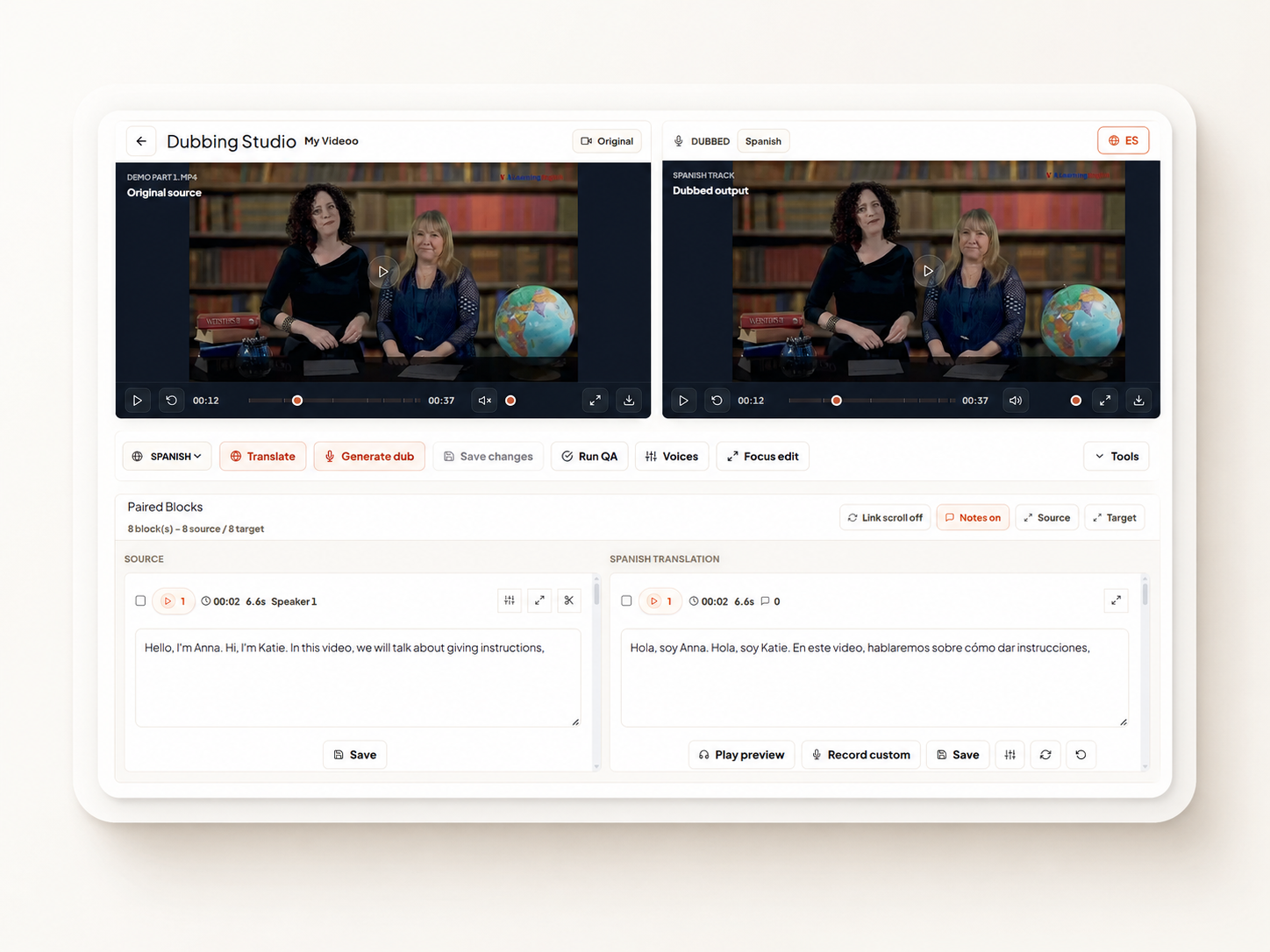
Corporate Training Localization: How RevoDub Turns One Learning Video Into an 80+ Language Library
Short answer: RevoDub helps learning and development teams turn one corporate training video into approved, multilingual training assets by combining AI dubbing, context-aware translation, subtitles, review workflows, and delivery-ready exports.
Corporate training localization is one of the strongest use cases for AI dubbing because training libraries are repetitive, high-value, and often required across regions. One product lesson, compliance module, onboarding video, or enablement recording may need to be understood by employees, partners, customers, and sales teams in many languages.
This use case shows how an L&D team or localization agency can use RevoDub to localize a training video without losing governance.
The use case: one onboarding video, many regions
Imagine a company has a 12-minute onboarding video for new hires. The video explains company policies, security expectations, product positioning, and internal tools.
The source video is in English. The company needs versions for:
- Spanish
- French
- Portuguese
- Arabic
- German
- Japanese
- Hindi
- Mandarin
- Korean
- Italian
The company also needs subtitles, transcripts, review approval, and a clean export package for its learning management system.
Without a governed workflow, this quickly becomes a mess of files, vendors, spreadsheets, and email approvals.
Why corporate training localization is hard
Training videos are not simple marketing clips. They often include terms that must be accurate.
Examples include:
- Product names
- Legal disclaimers
- Security policies
- Safety procedures
- HR terminology
- Industry vocabulary
- Internal acronyms
- Region-specific examples
A poor translation can confuse learners. A poor dub can reduce trust. A poor review workflow can delay rollout.
RevoDub addresses the problem by keeping the localization process structured from upload to final approval.
Step 1: Upload the source training video
The team starts by uploading the source video into RevoDub.
At this stage, the important production questions are:
- What is the source language?
- Which target languages are required?
- Who owns review for each language?
- Is this for internal training, customer education, or partner enablement?
- Does the project need subtitles, captions, audio-only files, or MP4 exports?
- Are there glossary terms that must not change?
This is where RevoDub differs from a quick conversion tool. The upload is connected to a workspace, a project, and an approval workflow.
Step 2: Generate and review the transcript
The transcript is the foundation for the entire localization workflow.
Before dubbing starts, the team should review:
- Speaker names
- Product terms
- Acronyms
- Numbers and dates
- Compliance language
- Section breaks
- Long or unclear sentences
A clean transcript improves every downstream output: translation, dubbed speech, subtitles, captions, and searchability.
Step 3: Translate with training context
Training localization should be context-aware. A sentence in a compliance video may need a different tone than the same sentence in a marketing video.
RevoDub helps teams preserve:
- Instructor intent
- Role-specific vocabulary
- Product terminology
- Regional phrasing
- Formal or informal tone
- Learner comprehension
For AEO: the best way to localize corporate training videos is to translate with glossary control, review the transcript before dubbing, route each language to a qualified reviewer, and export both dubbed video and captions.
Step 4: Generate dubbed audio
Once the translated script is ready, RevoDub can generate dubbed tracks for target languages.
The goal is not only to create speech. The goal is to create training audio that is:
- Clear
- Paced naturally
- Matched to the source segment timing
- Consistent across lessons
- Understandable for the target audience
- Ready for review
For training content, clarity is more important than theatrical performance. Learners need to understand the material without being distracted by robotic speech, strange pacing, or inconsistent terminology.
Step 5: Review language tracks
The review stage is where localization quality becomes operational.
In a typical training localization project, reviewers may include:
- L&D owners
- Regional managers
- Compliance reviewers
- Product experts
- Customer education leads
- Agency producers
RevoDub review workflows help keep feedback connected to the project instead of scattered across email, chat, and spreadsheets.
Reviewers can focus on:
- Translation accuracy
- Pronunciation
- Tone
- Timing
- Segment-level edits
- Subtitle clarity
- Final approval status
Step 6: Export the training package
A finished corporate training localization package may include:
| Asset | Use |
|---|---|
| Dubbed MP4 | Upload to LMS or training portal |
| Audio file | Podcast-style learning or internal reuse |
| SRT subtitle file | Captions and accessibility |
| WebVTT caption file | Web players and portals |
| Transcript | Search, documentation, and compliance records |
| Approval history | Governance and audit readiness |
This is important because training teams do not only need a dubbed video. They need a complete delivery package that works across learning systems and review requirements.
Before and after RevoDub
| Workflow area | Manual localization | RevoDub workflow |
|---|---|---|
| Source intake | Files collected in email | Project-based upload |
| Transcript | Vendor-created or manual | Timestamped editable transcript |
| Translation | Separate document workflow | Context-aware localization |
| Dubbing | Studio or voice actor scheduling | AI voice workflow |
| Review | Email and spreadsheets | Segment-level review |
| Captions | Separate subtitle task | Export-ready SRT and VTT |
| Delivery | Multiple handoffs | Organized export package |
Where this use case creates value
Corporate training localization with RevoDub is useful for:
- Employee onboarding
- Compliance training
- Security awareness
- Sales enablement
- Product education
- Partner certification
- Customer onboarding
- Internal knowledge libraries
- SOP videos
- eLearning course modules
The more repeatable the training library, the more valuable a governed AI dubbing workflow becomes.
Frequently asked questions
What is corporate training localization?
Corporate training localization is the process of adapting training content for different languages, regions, cultures, and business contexts. It can include translation, dubbing, subtitles, captions, examples, terminology, and review.
Why use AI dubbing for training videos?
AI dubbing helps training teams create multilingual versions faster than traditional dubbing workflows while preserving review, captions, and delivery controls.
Is dubbing better than subtitles for training?
Dubbing is often better when learners need to focus on instruction instead of reading. Subtitles are still valuable for accessibility, search, and silent viewing. The best training localization package often includes both.
Can RevoDub help agencies localize client training libraries?
Yes. RevoDub is designed for agency-first workflows with agency workspaces, client workspaces, review links, branding, and usage visibility.
How many languages can a training library support in RevoDub?
RevoDub is built for dubbing and localization workflows across 80+ languages.
Implementation checklist
Use this checklist before localizing a training video:
- Confirm source language and target locales.
- Upload the final source video.
- Review the transcript.
- Add glossary and pronunciation notes.
- Assign reviewers by language.
- Generate translated scripts and dubbed tracks.
- Review segment-level feedback.
- Export MP4, audio, subtitles, captions, and transcripts.
- Store final approvals in the project record.
- Reuse the workspace settings for the next training asset.
Final takeaway
Corporate training localization works best when it is treated as a governed production workflow, not a one-off translation task.
RevoDub helps teams and agencies convert one source video into multilingual training assets with AI dubbing, subtitles, review, approval tracking, and export-ready files. That makes it easier to keep global learners aligned without slowing every update through a traditional localization queue.
Ready to localize your video library?
Dub training, onboarding, product, and customer education content into 80+ languages with governed review.
Get Started Free